If you are drawn to Swampscott, chances are the water is part of the appeal. But in a town this compact, the real question is not whether you want coastal living. It is how close to the shoreline you want to be, and what that choice means for your budget, upkeep, and daily routine. This guide breaks down the tradeoffs between waterfront and inland living in Swampscott so you can decide which version of the town fits you best. Let’s dive in.
Why this choice matters in Swampscott
Swampscott is a small Atlantic coast town in Essex County that covers just 3.58 square miles and sits about 12 miles from Boston. It is also largely built out, which means there is very little undeveloped land left and much of the housing story is about redevelopment, infill, and making the most of existing locations.
That small footprint changes the way buyers think about “waterfront” versus “inland.” In many towns, inland can mean far from the coast. In Swampscott, even homes away from the immediate shoreline can still keep you close to beaches, the harbor, downtown destinations, and the MBTA station.
Swampscott’s coastal lifestyle at a glance
Swampscott’s identity is closely tied to its beaches and harbor. The town’s beach network includes Eisman’s/New Ocean House Beach, Fisherman’s Beach, King’s Beach, Phillips’ Beach, Preston Beach, and Whales Beach.
Each area offers a slightly different experience. Fisherman’s Beach supports boating and swimming and includes a pier, launching ramp, and town sailing programs, while Phillips’ Beach has daily lifeguards during the summer. Some beach parking areas require recreational parking stickers, so convenience can vary depending on where you live and how you plan to use the waterfront.
The town also continues to invest in its shoreline. Local planning highlights beaches, the waterfront, walkability, and the MBTA station area as important community assets, with ongoing attention to sea-level rise and shoreline protection.
What waterfront living looks like
Direct waterfront homes
In Swampscott, direct waterfront living is concentrated on oceanfront and harborfront streets such as Puritan Road, Ocean Avenue, Littles Point Road, and Beach Bluff Avenue. These homes often offer the most dramatic views, immediate water access, and a strong sense of place.
Current listing examples show how premium this category can be. Public listings include homes such as 251 Puritan Road at $4.95 million, 35 Littles Point Road Unit S201 at $3.799 million, 2 Ocean Avenue at $2.695 million, and 128 Ocean Avenue at $2.749 million.
If your goal is a front-row coastal experience, this segment delivers it. You are often paying for more than square footage alone. You are also paying for views, frontage, and the rarity of the location.
The appeal of waterfront ownership
Direct waterfront ownership can feel immersive in a way that inland homes cannot fully match. Depending on the property, you may have sweeping coastal views, beach access, or a strong connection to the harbor and shoreline from day to day.
For some buyers, that experience is the whole point. If your home is meant to maximize scenery, atmosphere, and a true oceanfront setting, waterfront property offers a lifestyle that is hard to replicate elsewhere in town.
What near-water living looks like
A balance of access and convenience
Near-water homes in Swampscott usually sit a few blocks from the beach or closer to the town center, commuter rail, restaurants, or Town Hall rather than directly on the shoreline. This category often appeals to buyers who want coastal access without taking on the full cost or exposure of direct oceanfront ownership.
Recent examples include 11 Boynton Street #201 at $749,000, 11 Boynton Street #101 at $729,000, 143 Burrill Street #301 at $829,999, 441 Essex Street #202 at $499,000, and 1008 Paradise Road Unit 3N at $425,000. In practical terms, this middle band often gives you a coastal lifestyle with more flexibility in price and property type.
More property-type variety
This is also where many buyers find a wider mix of housing options. Current examples include condo inventory ranging from smaller entry points to larger multi-bedroom homes, newer coastal condo construction, and adaptive-reuse properties like church conversions.
If you want a beach-oriented lifestyle but also care about lower maintenance, easier lock-and-leave ownership, or proximity to the commuter rail, near-water living may offer the most balanced fit. It can be a smart middle ground for buyers who want to enjoy Swampscott’s setting without stretching all the way into the direct waterfront tier.
What inland living looks like
Inland still feels coastal
Inland Swampscott is still part of a beach-centered town. Here, “inland” usually means being farther from the immediate shoreline and closer to the commuter rail, Vinnin Square, or the interior street grid.
The town’s master plan describes the MBTA station area as a transit village and Vinnin Square as a regional destination. That helps explain why many inland buyers focus on parking, yard space, and everyday convenience rather than water views.
More room for the dollar
For many buyers, inland Swampscott is less about giving something up and more about choosing a different priority. You may get more lot space, easier parking, and a lower maintenance load while still remaining close to beaches and town amenities.
Recent examples help illustrate the price contrast. Commuter-rail-area listings have included 222 Windsor Avenue at $695,000 and 6 Elmwood Road at $689,000, while a Tree Streets/Shaw Estate sale came in at $950,000, below recent beach-adjacent luxury pricing such as a Beach Bluff Victorian that sold for $2.295 million.
Comparing waterfront and inland tradeoffs
Budget and pricing
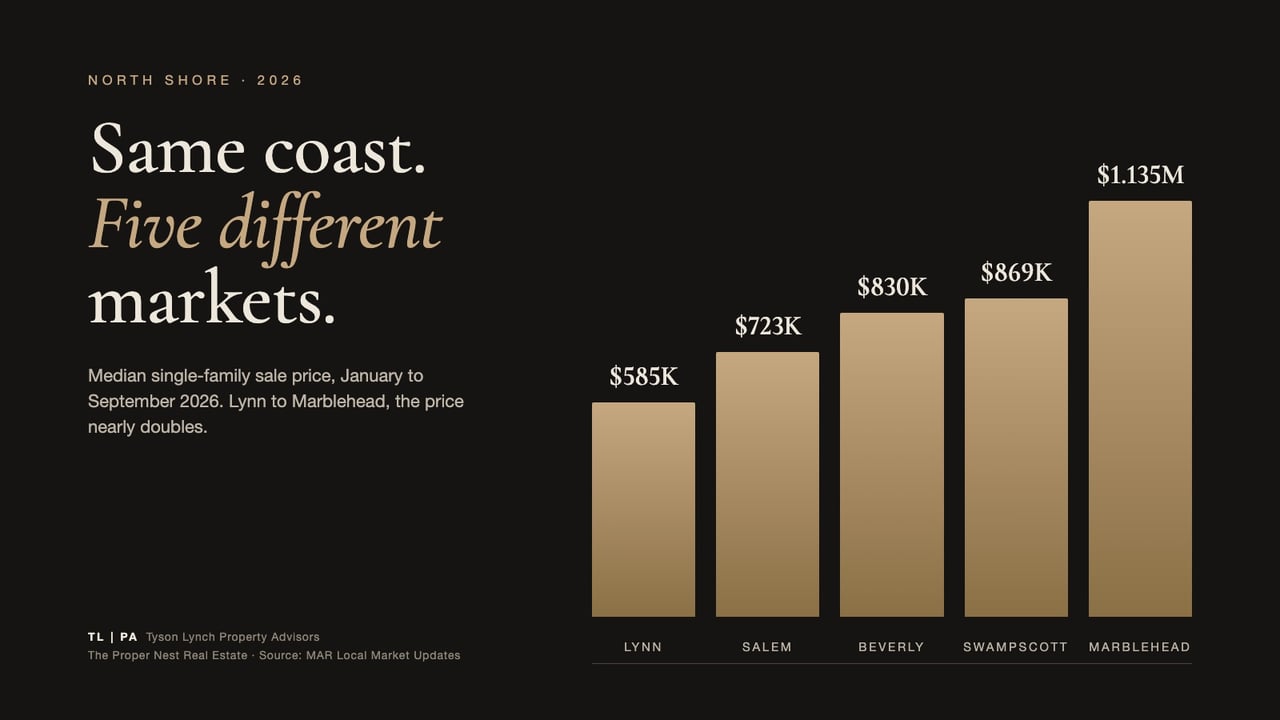
Swampscott remains a competitive market. March 2026 market trackers reported different median sale prices, with Redfin at $857,000 and Realtor.com at $699,000, both pointing to an active market and showing why broad averages should be read with context.
The clearest takeaway is the spread. Direct waterfront commands the highest premium, near-water condos and smaller homes can provide more accessible entry points by North Shore standards, and inland or transit-oriented homes often provide more space for the money.
Taxes and monthly carrying costs
Swampscott’s FY2026 residential tax rate is $12.00 per $1,000 of assessed value. That means rough annual tax carry works out to about $8,388 on a $699,000 home, about $10,284 on an $857,000 home, about $30,000 on a $2.5 million home, and about $59,400 on a $4.95 million home before insurance, maintenance, and any HOA costs.
This matters when comparing categories. A move from inland to direct waterfront is not only a purchase-price decision. It is also a long-term carrying-cost decision.
Maintenance expectations
Waterfront ownership typically brings more exterior wear. FEMA coastal construction guidance notes that buildings close to the ocean can experience much higher corrosion rates, especially near breaking waves and salt spray.
In plain terms, buyers near the shoreline should expect more attention to exposed materials like railings, decking, fasteners, and exterior finishes. Inland homes can still require upkeep, of course, but the coastal environment usually adds another layer of maintenance planning.
Flood exposure and permitting
One of the biggest practical differences between waterfront and inland living in Swampscott involves flood risk and permitting. The town’s floodplain overlay district applies to special flood hazard areas shown on the Essex County Flood Insurance Rate Map dated July 8, 2025, and development in the overlay requires permits.
The bylaw also states that owners seeking removal from the mapped floodplain must obtain a FEMA Letter of Map Amendment or Letter of Map Revision. For Zone VE properties, there are added restrictions, including requirements related to where new construction can be located.
For buyers, this can affect more than future renovations. It may also shape insurance requirements and financing, especially in high-risk flood areas tied to government-backed mortgages.
How to choose the right fit
Waterfront may fit you if
- You want the most immersive coastal experience
- Water views and direct access are top priorities
- You are comfortable with higher purchase prices and carrying costs
- You are prepared for added maintenance and flood-related considerations
Near-water may fit you if
- You want beach access without paying for full ocean frontage
- You value walkability to town amenities or the commuter rail
- You prefer more housing-type options, especially condos
- You want a middle ground between lifestyle and cost
Inland may fit you if
- You want more space, parking, or lot size for your budget
- You prefer a lower maintenance load
- You still want to stay close to beaches and the station
- You see Swampscott as a compact town where convenience matters as much as views
A practical way to think about it
In Swampscott, this decision is rarely about choosing between coastal living and non-coastal living. The town is simply too connected to the water for that. Instead, you are deciding how much of your budget should go toward views and frontage versus space, convenience, and lower exposure.
That is where thoughtful guidance matters. A home near the shoreline can be the right move if it aligns with your lifestyle, financing, and tolerance for upkeep. An inland property can be just as strong a fit if your priority is daily ease, value, and a little more room to breathe in a town that still keeps the coast close.
If you are weighing those options in Swampscott, working with an advisor who understands pricing tiers, contract details, and property-level tradeoffs can help you move with more clarity. When you are ready to compare locations, costs, and the real day-to-day implications of each choice, connect with Tyson Lynch | Property Advisors for a consultation.
FAQs
What is the difference between waterfront and inland living in Swampscott?
- Waterfront living usually means direct oceanfront or harborfront location with premium views and pricing, while inland living usually means being farther from the shoreline and closer to the commuter rail, Vinnin Square, or the town’s interior streets.
Are inland homes in Swampscott still close to the beach?
- Yes. Swampscott is a compact town, so many inland homes are still relatively close to beaches, downtown amenities, and the MBTA station.
Are waterfront homes in Swampscott more expensive?
- Generally, yes. Current examples show direct waterfront homes reaching into the multi-million-dollar range, while inland and near-water options often offer lower entry points.
Do waterfront homes in Swampscott have different maintenance needs?
- Yes. Homes closer to the ocean typically face more salt-air exposure, which can increase wear on exterior materials and hardware.
Do waterfront homes in Swampscott have flood-related rules?
- Yes. Some waterfront and near-water properties may fall within the town’s floodplain overlay district, which can affect permitting, insurance, and future improvements.
Is near-water living in Swampscott a good middle ground?
- For many buyers, yes. Near-water homes often provide beach access and coastal lifestyle benefits while offering more variety in price, housing type, and day-to-day convenience than direct waterfront homes.