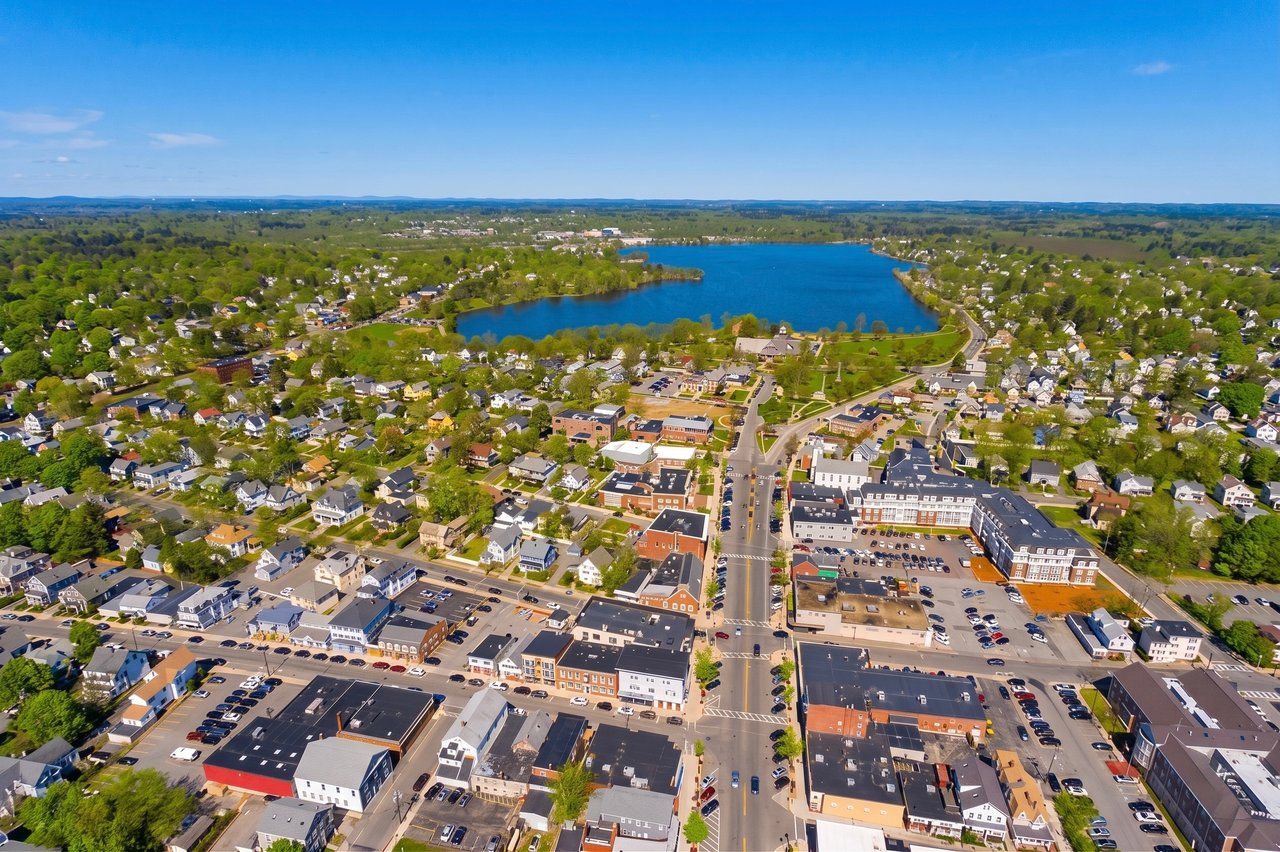
Lake Quannapowitt Living: Wakefield’s Best Neighborhoods for Active Families
Most buyers researching the North Shore never seriously consider Wakefield. That’s actually one of the reasons I like it.
The buyers who take Wakefield seriously tend to end up there.
What Wakefield Actually Offers (That Most People Don’t Know)
Lake Quannapowitt is 197 acres sitting in the middle of a residential town, 11 miles north of Boston. It has a 3-mile perimeter path that gets real use — runners, cyclists, families with strollers, people walking dogs at 6am and 6pm. The lake itself supports sailing, kayaking, and rowing. In July, it hosts one of the better Fourth of July celebrations on the North Shore.
This isn’t a lake tucked behind a neighborhood. It’s central to the town’s identity. The park system wraps the entire perimeter, which means access isn’t limited to the houses directly on the water — most of the neighborhoods near the lake have an easy walk to the path.
For families specifically, that’s a different quality of daily life than you get in a comparable suburb. The outdoor infrastructure is already built. You’re not hoping for it.
The Neighborhoods Worth Knowing
Wakefield isn’t a large town — about 27,000 residents, roughly 10 square miles — but the neighborhoods around the lake each have a distinct character worth understanding before you start looking at listings.
The Lake Quannapowitt Area (West Side)
The streets running along the western and northern edges of the lake are Wakefield’s most sought-after addresses. Homes here range from well-maintained Colonials and Capes to larger single-family properties with direct lake views. Prices reflect the demand — you’re typically looking at $900,000 and up for lakefront or near-lakefront, with true water-view properties pushing well past $1,000,000.
What you’re paying for is immediate access. Morning coffee on a porch overlooking the water, kids walking to the path after school, the ability to put a kayak in without loading it on a roof rack. For families who moved to the suburbs specifically for outdoor lifestyle, this is the neighborhood that delivers on that completely.
Greenwood
Greenwood sits southeast of the lake and has its own commuter rail stop on the MBTA Haverhill Line — a detail that matters more than most buyers initially realize. If one or both partners commute to Boston, having a walkable commuter rail station changes the calculus significantly.
The housing stock in Greenwood skews toward well-kept single-families, with a median sale price around $810,000 and a range that runs from the mid-$700s up to $1.6M for larger or fully renovated homes. Some multi-families are mixed in closer to the station. The neighborhood has a settled, residential feel — good schools nearby, quiet streets, a genuine sense of an established community.
For buyers who want North Shore lifestyle without sacrificing an easy commute, Greenwood is one of the better-kept secrets in the region.
Downtown Wakefield
The downtown is walkable and functional — not a destination, but a legitimate neighborhood anchor. There are restaurants, coffee shops, local retail, and the kind of day-to-day infrastructure that makes a town livable rather than just pretty. Homes in and around downtown sit at a slightly lower price point than lakefront properties, making them a reasonable entry point for buyers stretching their budget.
The proximity to MBTA service is also good from downtown — the main Wakefield station on the Haverhill Line provides direct service to North Station in about 35 minutes.
Crystal Lake Area (East Side)
On the east side of town, the Crystal Lake neighborhood offers a quieter, more wooded setting. Lot sizes tend to be larger here, and the housing stock includes more ranch-style and mid-century homes alongside newer construction. Families who prioritize outdoor space and privacy over walkability to the main lake path often end up in this pocket.
Prices here are typically more accessible than the lakefront west side, and the school access is comparable across the town.
Schools — The Question Every Family Asks
Wakefield runs a single public school district, which simplifies things. The system is consistently well-regarded by the communities it serves — Wakefield High School has strong academic offerings and a competitive athletics program, which matters to families with kids approaching high school age.
Elementary school assignments vary by neighborhood, but the district overall is a consistent draw for families relocating from Boston or other parts of the North Shore. It’s one of the reasons buyer demand in Wakefield remains steady even when the broader North Shore market softens.
What the Market Looks Like Right Now
Wakefield is not a slow market. Homes priced correctly move — often quickly, often with multiple offers. The combination of commuter rail access, lake lifestyle, and school quality creates consistent demand from a specific type of buyer: families relocating from Boston who want more space and better schools without landing somewhere that feels disconnected.
The median sale price in early 2026 sits around $870,000, and the sweet spot for most buyers is the $750,000–$950,000 range — where you can get a well-maintained single-family with reasonable square footage and proximity to the lake path. Lakefront and lake-view properties push above $1,000,000, and the top end of the market runs to $2M+ for the right house on the right street.
What I’d tell a buyer right now: Wakefield rewards preparation. The homes that check all the boxes — lake proximity, good school zone, commuter rail access — don’t sit. If you’re serious about the town, you need to be ready to move.
Getting to Boston From Wakefield
The MBTA Haverhill Line serves Wakefield with two stations — Wakefield and Greenwood — providing direct service to North Station. The commute runs approximately 30–40 minutes depending on which train you catch, with service running throughout the day and into the evening.
For buyers who work in the Financial District, Back Bay, or anywhere accessible from North Station, this is a legitimate commute — not a compromise. And compared to what that commute costs you in a town like Winchester or Melrose, Wakefield often gives you more house for the same dollar.
By car, Route 128 is close, giving solid access to the tech corridor and the broader North Shore. The combination of rail and highway access puts Wakefield in a genuinely useful geographic position.
Is Wakefield the Right Town for Your Family?
Wakefield tends to be the right answer for a specific buyer profile, and it’s worth being honest about what that looks like.
It’s a strong fit if you want outdoor lifestyle built into daily life — not something you have to drive to. If the commuter rail matters to your household. If good public schools are a requirement. And if you want to get real value relative to the lifestyle you’re buying.
It’s less of a fit if you’re drawn to the coastal, oceanfront character of Salem or Swampscott — Wakefield is a lake town, not a coastal one, and that’s a real distinction for some buyers.
I currently have a property on the market in Wakefield. If you’ve been looking on the North Shore and haven’t seriously considered this town, I’d encourage you to take a look — at the listing and at the town itself. Sometimes the right place is the one you’ve been walking past.