If you want a North Shore town with a direct rail link to Boston, Manchester-by-the-Sea is probably already on your list. The appeal is easy to understand: a compact downtown, a commuter rail station in the center of town, and a coastal setting that feels distinct from larger rail communities. But for Boston commuters, the real question is not whether Manchester is attractive. It is whether the commute, parking, and housing options line up with how you actually live day to day. Let’s dive in.
Why Manchester works for commuters
Manchester-by-the-Sea is a true commuter-rail town on the MBTA Newburyport/Rockport Line. The town’s own downtown parking study treats the station as one of downtown’s core assets, which tells you how central rail access is to daily life in town.
That matters if you want a place where the train is part of the local rhythm, not an afterthought. It also matters for long-term planning, since Manchester is classified as an MBTA community and the station area is part of the town’s broader housing conversation.
The key train schedule caveat
Here is the most important detail for Boston commuters: not every train stops in Manchester. The current timetable shows that many trips on the line are marked as not stopping there, while Manchester appears on only a subset of departures.
So yes, Manchester is a realistic commuter town for Boston. But it works best if you can plan around the schedule rather than expecting the kind of flexibility you may find in larger towns where every train stops.
Best fit for planned commuters
If your work hours are fairly predictable, Manchester can be a strong option. If your schedule changes often, or you rely on frequent reverse choices throughout the day, the limited stop pattern is something to weigh carefully.
That does not make the town less viable. It just means the commute experience is more schedule-dependent than some buyers initially assume.
Driving to Boston as a backup
If you drive instead of taking the train, current route planners estimate roughly 41 to 45 minutes from Manchester-by-the-Sea to Boston in uncongested conditions. That is useful as a baseline, especially if you want a backup plan for days when rail timing does not work.
The important word there is baseline. It should not be treated as a rush-hour promise, but it does give you a general sense of where Manchester sits in relation to the city.
Parking can shape your routine
For many commuters, the daily routine is not just about train time. It is about how easily you can get to the station and where you can leave your car.
Manchester’s station parking story is appealing on cost. The MBTA parking-rate table lists Manchester as free on weekdays and weekends, which compares favorably with nearby stations like Beverly, Salem, and Swampscott, where paid parking is the norm.
Free parking is a real advantage
For commuters watching monthly carrying costs, free station parking can make a difference over time. In nearby towns, regular parking fees add up quickly, so Manchester’s pricing stands out.
That said, free does not mean unlimited. Buyers who expect to drive to the station regularly should look at the parking setup as closely as they look at the train schedule.
Supply is limited downtown
The town says downtown has limited public parking. That includes 2-hour parking on Beach Street, about 50 spaces at Town Hall, about 20 spaces at Masconomo Park, and the MBTA commuter parking lot behind the Manchester Community Center at 40 Beach Street.
A regional downtown parking study counted 485 spaces in the study area and noted that 87% of on-street spaces have a two-hour limit. The same study identified 34 MBTA commuter-rail spaces in the private lot at 40 Beach Street.
A compact downtown changes the commute
One of Manchester’s real strengths is its size. The downtown study describes the area as just under half a mile long, or about a ten-minute walk end to end, with the core business area closer to a five-minute walk end to end.
For you as a buyer, that means a few blocks can have a big impact on daily convenience. A home near the Bridge, Central, Union, Beach, or Summer Street corridor may support a more walkable station routine, while other homes may turn the same commute into more of a drive-and-park setup.
Walkability is block-by-block
In a compact town like Manchester, “near the station” is not always a broad category. It can be very specific.
That is why commute-focused home searches here tend to work best when you zoom in on exact location, not just town name. The difference between an easy walk home and a car-dependent routine may come down to a short stretch of downtown.
What housing looks like near transit
Manchester sits at the high end of the North Shore commuter-rail price spectrum. Redfin’s May 2026 snapshot shows a median sale price of $1,424,148, with a median of 24 days on market and 12 homes sold that month.
That last number matters. With a relatively small number of monthly sales, pricing can move around based on the mix of homes that close, so buyers should treat the median as a snapshot rather than a fixed rule.
Expect limited station-area inventory
If you are hoping for a large pool of condo choices near the train, Manchester is usually not that kind of market. Recent sales show that condo inventory exists, but it is limited and still expensive.
Examples in the recent sales mix include a two-bedroom, two-and-a-half-bath condo at 21 Pine Street #5 that sold for $925,000, along with single-family sales such as 7 Walker Road at $1.19 million and 6 Magnolia Avenue at $1.3 million. In practical terms, that suggests commuters are often competing for a small number of condos or smaller homes rather than a broad apartment-style inventory base.
How Manchester compares with nearby rail towns
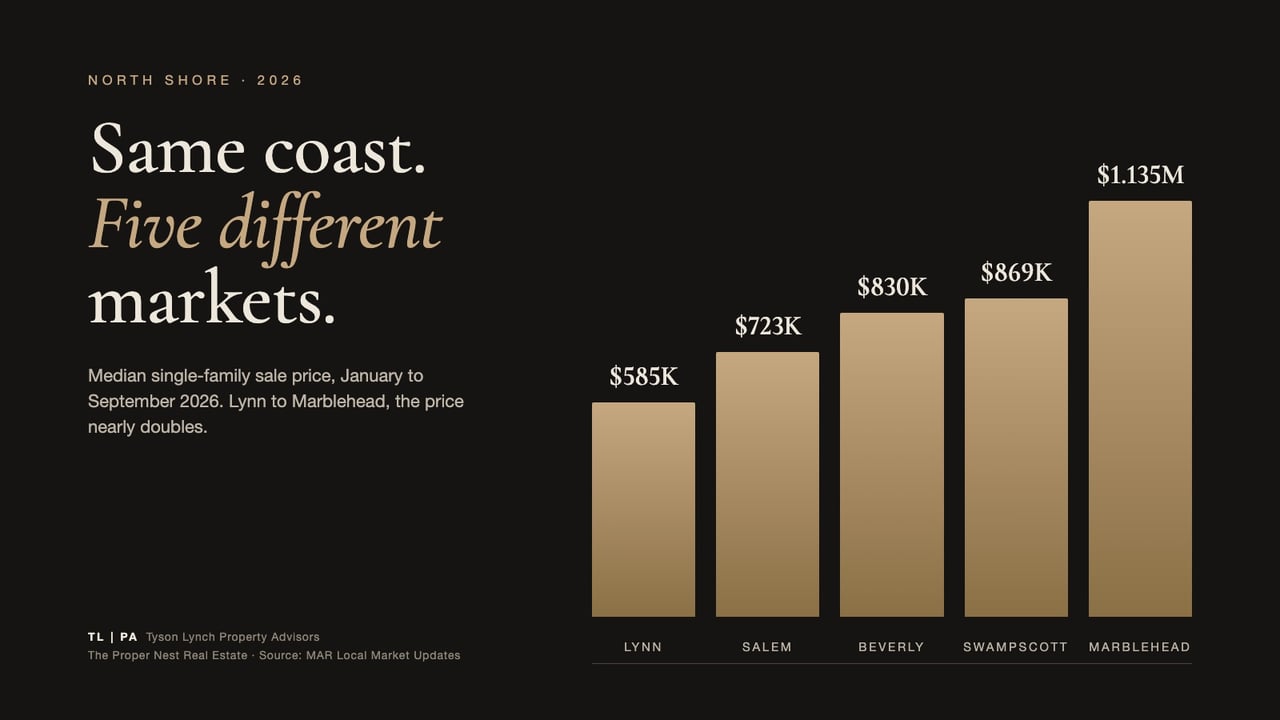
If you are balancing commute convenience with budget, Manchester makes the most sense when you compare it directly with nearby North Shore options. The tradeoffs become much clearer when you look at pricing, inventory type, and station experience side by side.
| Town | Median sale price | Commuter takeaway |
|---|---|---|
| Manchester-by-the-Sea | $1,424,148 | Premium rail town with limited station-area housing |
| Beverly | $804,000 | Broader price range and more entry-level commuter options |
| Salem | $589,647 | Most accessible pricing among these compared rail towns |
| Swampscott | $857,000 | Coastal alternative with a lower median than Manchester |
Beverly offers more flexibility
Beverly’s median sale price was $804,000 in the same period. Recent sold data there included condos in the low-to-mid $300,000s and $400,000s, plus single-family homes in the $700,000s.
For buyers who want commuter access with a wider spread of price points, Beverly offers more flexibility than Manchester. It is often the middle-ground option in this comparison.
Salem is the value option
Salem’s median sale price was $589,647. Recent sales included multiple condos and smaller homes in roughly the $400,000 to $637,500 range.
Among these rail towns, Salem offers the most accessible price point. If your priority is getting onto the North Shore commuter map with a lower entry cost, Salem deserves a close look.
Swampscott is a coastal alternative
Swampscott’s median sale price was $857,000, with a mix of houses, condos, and townhouses in the market. It sits between Beverly and Manchester on price.
For buyers drawn to a coastal setting but hesitant about Manchester’s price level, Swampscott can be a useful comparison point. It offers a different station and parking profile, but it often enters the conversation for the same lifestyle-oriented buyer.
The long-term station-area story
Manchester’s station area is not only about today’s commute. It is also a likely focal point for future housing planning.
Under the MBTA Communities law, towns like Manchester must provide at least one multifamily district of reasonable size within a half mile of transit. Manchester’s own MBTA zoning page says the town is studying that requirement locally, which makes the station area especially important for buyers who are thinking about long-term housing mix and change over time.
Is Manchester worth it for Boston commuters?
For the right buyer, yes. Manchester-by-the-Sea offers direct commuter rail access, free station parking, and a compact downtown that can support a very convenient daily rhythm if you buy in the right location.
The tradeoff is that you are paying for a small-scale, premium commuter town. Train service is less flexible than in some larger rail communities, station-area housing is limited, and median pricing is much higher than Beverly, Salem, or Swampscott.
If your budget allows for it and your work schedule is predictable, Manchester can be a compelling match. If you want more price flexibility or a wider range of condo options, nearby rail towns may offer a better fit.
If you want help comparing Manchester-by-the-Sea with other North Shore commuter towns, or you want a clearer picture of which blocks and housing types best fit your routine, Tyson Lynch | Property Advisors can help you sort through the tradeoffs and make a confident plan.
FAQs
Is Manchester-by-the-Sea a realistic town for Boston commuters?
- Yes. Manchester has direct commuter-rail access to Boston, but only a subset of trains stop there, so it works best if you can plan around the schedule.
Is Manchester-by-the-Sea station parking free?
- The MBTA parking-rate table lists Manchester parking as free on weekdays and weekends, though buyers should still account for limited supply and station access.
Is parking easy in downtown Manchester-by-the-Sea?
- Downtown parking is limited, with a mix of 2-hour street parking, public spaces at Town Hall and Masconomo Park, and a relatively small dedicated commuter-rail allocation at 40 Beach Street.
What kind of homes can commuters expect in Manchester-by-the-Sea?
- Most commuters will find a market skewed toward expensive single-family homes, with a small number of condo opportunities near the station area.
How does Manchester-by-the-Sea compare with Salem, Beverly, and Swampscott?
- Manchester is the highest-priced option of the group, Beverly offers more price flexibility, Salem has the most accessible pricing, and Swampscott is a coastal alternative with a lower median sale price than Manchester.
Are homes near the Manchester-by-the-Sea station likely to matter more in the future?
- Yes. Because Manchester is an MBTA community studying local zoning requirements tied to transit, the station area is likely to remain important in the town’s housing conversation.