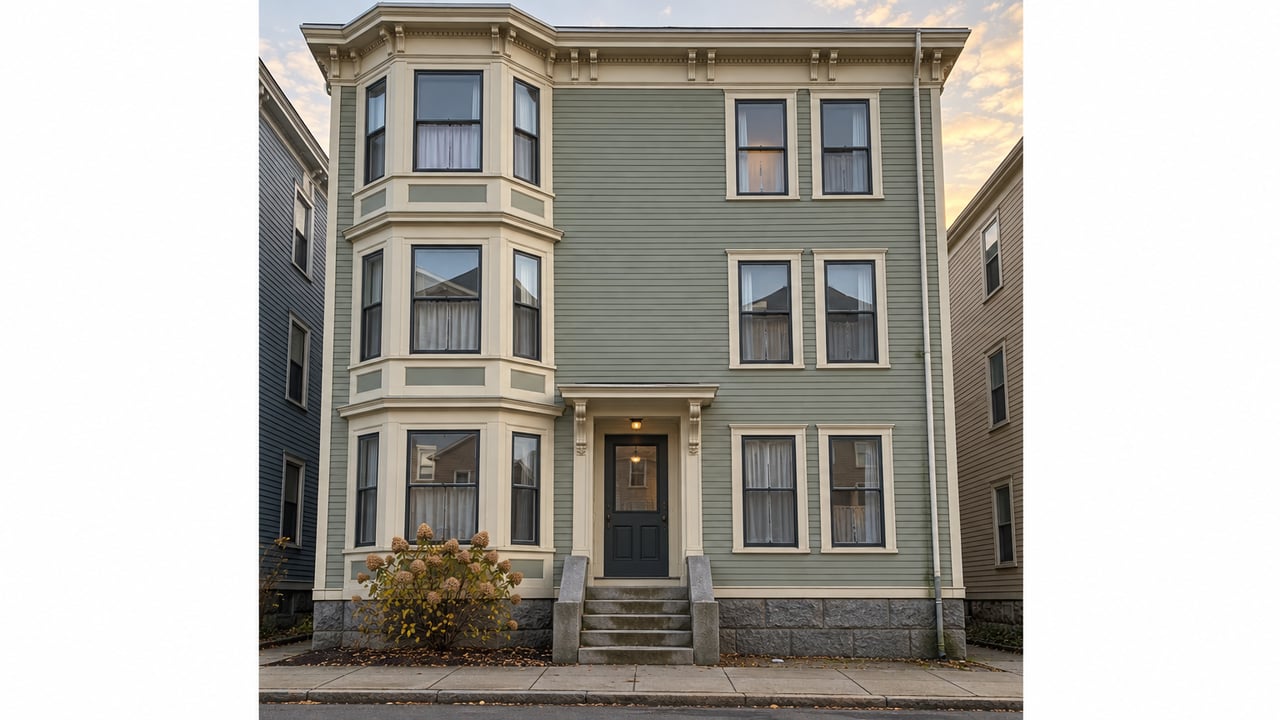
An investor finds a classic Lynn triple-decker near downtown, three units, decent bones, priced to move. The plan writes itself: live in one unit, rent the second at market, list the third on Airbnb to cover more of the mortgage. It is the same playbook that works in a dozen other Massachusetts gateway cities. Then the investor calls the city's Inspectional Services Department to ask about a short-term rental permit for that third unit, and the plan stops there. Lynn only issues full-unit short-term rental licenses to owner-occupied single-family homes. An investor-owned unit inside a multi-family building needs special approval to operate as a short-term rental at all, which is a different and slower conversation than the one most out-of-town buyers expect to have.
That single rule reorders the math on nearly every triple-decker deal in the city, and it rarely shows up in the spreadsheets investors build before they call a local agent or lender.
What the Ordinance Actually Restricts
Lynn's short-term rental framework sorts units into a few categories, and the one that matters most for investors is the home-share license for an entire unit. That license is written for an owner's primary residence, not for a non-owner-occupied apartment inside a multi-family building. A buyer who wants to run the third floor of a triple-decker as a nightly rental while living somewhere else, or while treating the whole building as an investment, is applying for something the ordinance does not hand out by default. The city's short-term rental page lays out the application steps, and the special-approval path exists, but it is not the fast lane that Airbnb arbitrage strategies depend on elsewhere.
This matters because the strategy that makes a lot of small multi-family math work in Greater Boston, house-hack one unit and short-term-rent the others, runs into a wall in Lynn that it does not run into everywhere. An investor who prices a deal assuming nightly rates on two units and finds out mid-underwriting that only long-term leases pencil is not looking at the same deal anymore.
The Median That Isn't Really One Number
Set the short-term rental question aside and look at what Lynn's headline price is doing, because the citywide number tells a story that falls apart the moment you zoom into a specific street.
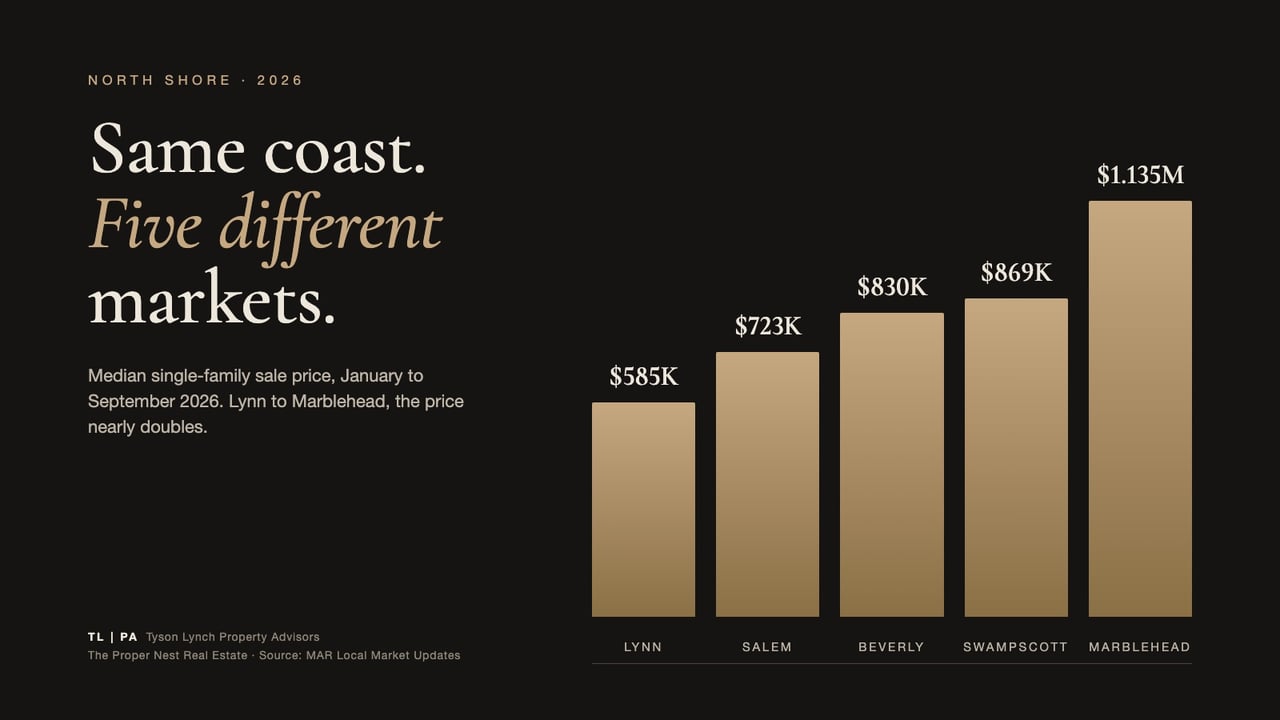
Over the three months ending May 2026, Lynn's citywide median sale price sat at $585,000, down 2.6 percent from the same period a year earlier. Read on its own, that looks like a market cooling off. But the neighborhoods inside Lynn were not moving together.
| Area | Median Sale Price | Year-Over-Year Change |
|---|---|---|
| Lynn, citywide (3 mo. ending May 2026) | $585,000 | down 2.6% |
| West Lynn (3 mo. ending May 2026) | $632,000 | up 11.9% |
| Lynnway (3 mo. ending May 2026) | $625,000 | down 5.3% |
| Downtown Lynn (single month, Nov. 2025) | $365,000 | up 18.5% |
West Lynn ran hot. The Lynnway corridor cooled faster than the city average. Downtown Lynn posted the biggest jump of all, but on a base of just eight home sales that month, which is small enough that one or two unusual transactions can swing the percentage by double digits. That is not a reason to dismiss the number, it is a reason to treat it as a signal worth confirming against more sales before betting a purchase price on it.
The practical read for an investor is that "Lynn is cooling" and "Lynn is heating up" are both defensible headlines depending on which three streets you are underwriting. A citywide median is a useful sanity check. It is not a substitute for pulling comps on the actual block where the building sits.
What a Triple-Decker Actually Pencils Out To
Run a realistic example. A three-unit building with two two-bedroom apartments and one one-bedroom, using rents in line with current Lynn listings, two-bedrooms around $2,400 a month and the one-bedroom around $1,975, produces gross scheduled rent near $81,300 a year. Apply a conservative 5 percent vacancy and collection loss and effective gross income lands around $77,000. Budget operating expenses and reserves at roughly 40 percent of that, a fair assumption for a building with the deferred maintenance common in Lynn's older two- and three-family stock, and net operating income comes out near $46,000. At a 6 percent capitalization rate, a rate regional investors commonly apply to smaller North Shore multi-family deals rather than core-Boston pricing, that NOI implies a value close to $767,000.
Compare that to what multi-family listings in Lynn were actually asking. Active multi-family inventory in the city has spanned a wide range, with dozens of properties on the market and asking prices for multi-family stock running well above the single-family median, reflecting both larger unit counts and land value near downtown and the waterfront. The gap between what a conservative NOI supports and what a seller is asking is exactly where negotiation and inspection findings do their work, and it is also where a buyer's assumptions about vacancy, rent growth, and permitted uses either hold up or fall apart.
The Cost Line Most Spreadsheets Skip
Every rental unit in Lynn, including condominium units, has to be registered annually with the Inspectional Services Department and inspected once every five years. The current ordinance sets the initial registration at $25 with a $15 per unit annual renewal, a $100 inspection fee, and a $25 reinspection fee if something needs fixing. None of that is expensive on its own. What is expensive is the fine for skipping it: $300 a day for a long-term rental property that is not registered.
The city has been actively enforcing this. Inspectors going through Lynn's roughly 18,000 rental units over the program's history have turned up code violations ranging from missing smoke detectors to fully illegal apartment setups, including basement units without proper egress. A buyer who assumes a triple-decker's third unit is a legal, rentable apartment because the listing calls it one should confirm that against the city's own registration records before closing, not after. That same diligence extends to Massachusetts lead paint requirements.
None of these are large dollar figures individually. Together they are the difference between a deal that clears a lender's debt service coverage threshold, typically somewhere around 1.20 to 1.35 on small multi-family loans, and one that does not.
Where the Institutional Money Is Already Positioning
The clearest signal that professional capital still likes Lynn's fundamentals came in March 2026, when Lynnway Park, a 17-acre former dairy processing site at 626 to 680 Lynnway that has been converted into logistics and light industrial space, sold for $40 million to North River Company. The site, once home to Garelick Farms and West Lynn Creamery, now counts Wash Cycle Laundry as a tenant occupying roughly 44,000 square feet, and the sale closed as part of a broader waterfront push meant to connect the Lynnway corridor back to downtown.
That push has a name and a document behind it. The city's South Harbor Implementation Plan lays out the infrastructure investments the waterfront district needs to support future housing and commercial development, and city planners have been exploring whether Lynn needs its own urban renewal authority to move stalled and vacant waterfront parcels forward. None of that guarantees a timeline for residential investors. It does mean the capital already active in Lynn is betting on the waterfront corridor specifically, which is a useful data point for an investor deciding whether to target a triple-decker near the Lynnway or one closer to Diamond District or Downtown.
The number that should change an investor's approach to Lynn is not the citywide median. It is the combination of what a specific block's comps actually show, what the rental ordinance actually permits for that unit mix, and what registering and inspecting that building will cost every year it is held. Those three numbers, not the one on the portal, are what decide whether a deal works.
If you are underwriting a Lynn multi-family purchase and want someone who can walk the rental ordinance, the permitted use, and the actual comps for a specific address before you write an offer, Tyson Lynch works this exact corner of the North Shore investor market and can get you a straight answer before you're under contract.
This article is general information, not legal, tax or financial advice. Consult a qualified professional about your situation.